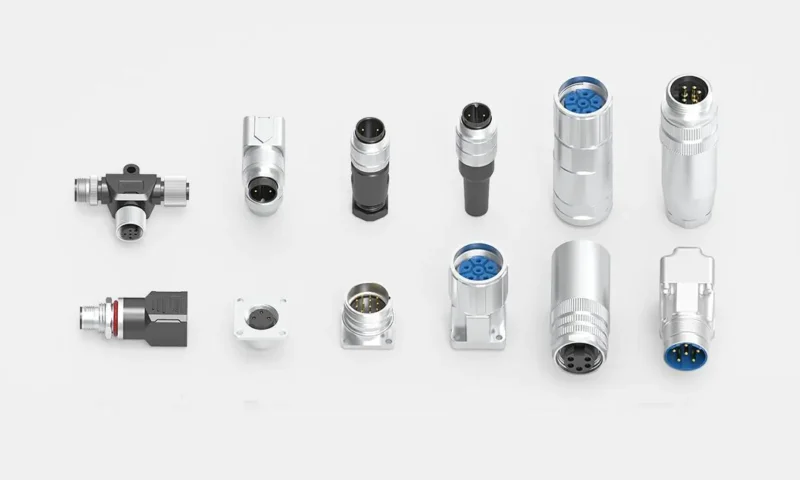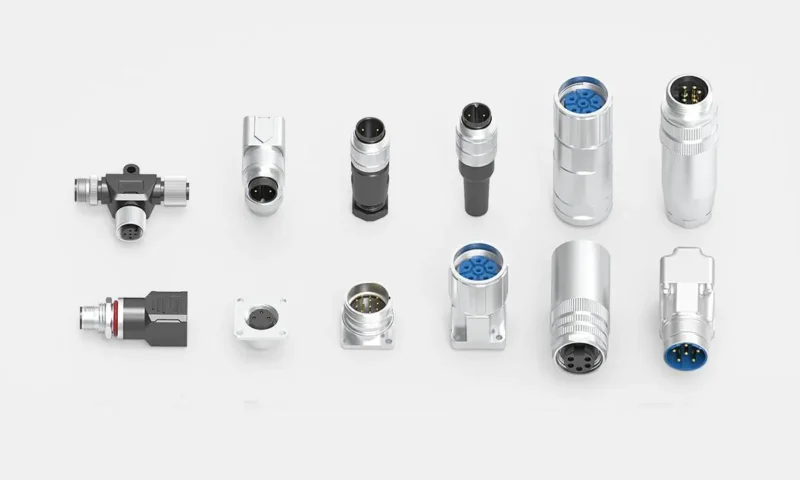
When selecting connectors for industrial automation systems, engineers often face the M12 vs. M8 dilemma. However, the real technical focus isn’t size—it’s coding. The coding determines signal integrity, power transmission, and protocol compatibility.
Here is a technical g1. M12 Connector Coding Explained
1.With its rich coding options, theM12 connector is the backbone of industrial automation.
S/K/L-Coding: Power transmission specialists. S/K coding supports 12A/630V (AC power), while L coding supports 16A/63V (DC power).uide based on industry standards (IEC 61076-2-101/104) to help you make the right decision.
A-Coding: The gold standard for sensors and actuators. Supports DC power, DeviceNet, and IO-Link. Available in 3 to 17 pins with a current rating of 1.5–7.5A.
B-Coding: Dedicated to fieldbus. A 5-pin design optimized for Profibus (PROFIBUS DP) and Interbus, widely used in process automation.
D-Coding: Built for industrial Ethernet. A 4-pin configuration designed for 100Mbps PROFINET and EtherCAT, replacing unstable RJ45 connectors in high-vibration environments.
X-Coding: The king of high-speed data. An 8-pin design with individually shielded pairs supporting 10Gbps (Cat6a), ideal for vision systems and high-bandwidth IIoT backbones.
2. M8 Connector Coding Explained
When installation space is limited, the M8 connector is the ideal choice for compact sensors—approximately 30% smaller than M12.
- A-Coding: The most common M8 coding. Designed for sensor/actuator signals and low-power devices. Available in 3–4 pins with a current rating of 1.5–4A.
- B-Coding: Dedicated coding for DeviceNet and CANopen. Optimized for CAN bus networks and fieldbus communication applications.
- D-Coding: Use with caution. Some M8 D-coded connectors support 100Mbps Ethernet, but not all protocols are compatible. Prioritize M12 D-coding for industrial Ethernet.
3. How to Choose Between M12 and M8 Codings?
Follow this technical roadmap:
| Requirement | Recommended Coding |
|---|---|
| High-speed data (1–10Gbps) | M12 X-coding (M8 not supported) |
| Industrial Ethernet (100Mbps) | M12 D-coding (M8 D-coding only for space-constrained cases) |
| Sensor/actuator signals (compact) | M8 A-coding |
| Sensor/actuator signals (more pins) | M12 A-coding (12–17 pins) |
| Fieldbus – Profibus | M12 B-coding (5-pin) |
| Fieldbus – DeviceNet / CANopen | M8 B-coding |
| Dedicated power delivery | M12 L/S/K-coding (M8 not supported) |
Final advice: Before selecting a coding, always check the coding letter on your device port label or technical documentation. Using the wrong coding can result in connector damage or system failure.