As Industry 4.0 and smart sensing technologies continue to advance at an unprecedented pace, device miniaturization and integration have become top priorities for design engineers. One of the most critical challenges lies in achieving reliable signal transmission within extremely limited space. The M5 circular connector, with its thread diameter of just 5mm, has emerged as a key solution to this problem.
However, the market is flooded with various M5 connectors, each offering different specifications. This article provides a practical selection guide for compact sensor designs by breaking down key technical parameters and real-world application scenarios.
Technical Deep Dive: Balancing Size and Performance
The core of connector selection lies in understanding technical specifications. Although the M5 connector is small, its electrical and mechanical performance directly determines whether a sensor can survive in harsh industrial environments.
1. Key Electrical Parameters: The “1A & 60V” Rule
In the field of miniature sensors, rated current and voltage are the first parameters to consider. Most standard M5 connectors comply with the IEC 61076-2-105 standard, typically featuring 1A per contact and 60V. This makes them naturally suitable for low-power signal transmission applications such as photoelectric switches and proximity sensors. If your design involves high-power actuators, upgrading to M8 or M12 series is recommended.
2. Contact Configurations: Choosing Between 3-Pin and 4-Pin
M5 connectors are commonly available in 2-pin, 3-pin, and 4-pin options.
- 3-pin configuration: The most common “signal + power” combination, suitable for simple discrete signal transmission.
- 4-pin configuration: Increasingly popular in compact designs. It allows for simultaneous power and signal transmission within a single interface, and even reserves channels for future IO-Link communication, laying the hardware foundation for device intelligence.
3. Ingress Protection and Environmental Durability
Dust and moisture are the number one enemies of connectors in industrial settings. A qualified M5 connector must achieve at least IP67 protection rating when mated (some high-end models offer IP68/IP69K). This means it can withstand washdowns and even operate under temporary water immersion. Additionally, pay attention to the operating temperature range (typically -25°C to +80°C), which is critical for outdoor or extreme-condition sensors.
4. Mechanical Design: The Straight vs. Angled Trade-off
Since M5 connectors are mostly used in extremely tight spaces, mechanical design becomes a key differentiator.
- Straight version: Suitable for applications where the cable exits without obstruction.
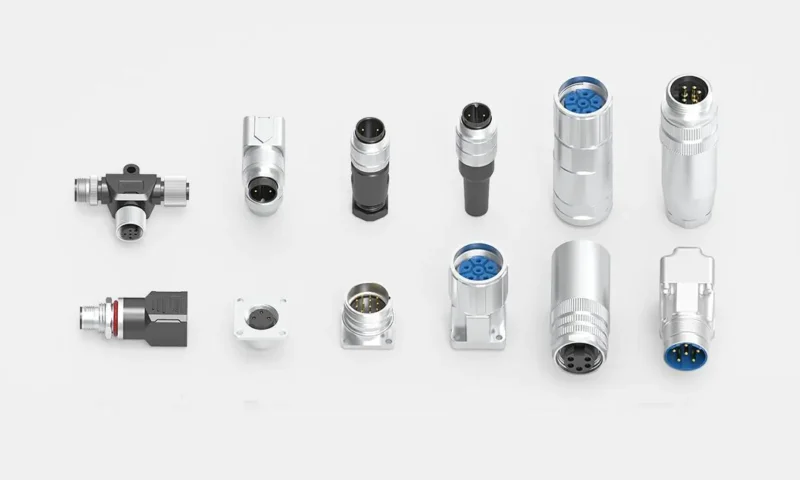
- Angled version: A recent innovation in the market. For example, Binder’s new M5 angled panel-mount connector features a housing size reduced to just 7.5mm x 7.5mm. This design allows sensors to sit flush against equipment surfaces with extremely low installation height, solving the physical “cable bump” issue that straight connectors often cause in thin-profile devices.
| Parameter | M5 Connector Typical Spec | Reference (M8) | Technical Insight |
|---|---|---|---|
| Thread Size | M5 x 0.5 | M8 x 1.0 | Ultimate compactness for miniature devices |
| Rated Current | Approx. 1A | 2A – 4A | Ideal for signal & low-power sensor connections |
| Contact Options | 2, 3, 4 pins | 3 – 8 pins | 4-pin enables power+signal in one interface |
| Protection Rating | IP67 (IP68 optional) | IP67 / IP68 | Excellent dust and water resistance |
| Key Innovation | Angled (7.5mm height limit) | Straight dominant | Solves PCB and thin-housing clearance issues |
Real-World Applications: From Robot Arms to Miniature Sensors
Theoretical parameters must be validated in real applications. Thanks to their small size and high precision, M5 connectors are replacing traditional terminal blocks in the following high-tech fields.
Application 1: Collaborative Robot End Effectors
In collaborative robots (Cobots), every gram and every millimeter counts — especially in the wrist joint where sensors are installed. M5 angled panel-mount connectors are ideal here. They maintain a minimal bending radius during robotic arm rotation to prevent cable tangling, while offering 100+ mating cycles (industrial-grade products can achieve 500+ cycles), meeting the rapid tool-changing requirements of end effectors such as grippers and suction cups.
Application 2: Miniaturized Industrial Cameras & Vision Systems
With the rise of AI machine vision, smart cameras are becoming increasingly compact. In the past, large connectors forced camera bodies to be wider. Today, design engineers can use 4-pin M5 connectors to integrate both power supply and digital signal transmission into a single miniature interface, shrinking the camera body to the size of a thumb — small enough to fit into narrow inspection stations.
Application 3: Smart Home & Building Automation Sensors
In modern building automation, miniature sensors (such as door/window contacts and occupancy sensors) are often embedded in ceilings or walls. These devices are extremely sensitive to thickness. M5 panel-mount connectors can be soldered directly onto PCBs and mated with overmolded cables to provide power and data backhaul. This design not only simplifies field wiring but also ensures long-term reliability in humid environments (e.g., swimming pools, bathroom facilities) thanks to IP67 protection.
Recommended Solution: Xmost Industry’s Miniature Connector Portfolio
Given these demanding selection criteria, having a reliable supplier with high compatibility and customization capabilities is essential. To meet the needs of compact sensor designs, Shenzhen Xmost Industry Co., Ltd. offers a highly competitiveM5 connector portfolio built for the toughest industrial automation challenges.
Xmost Industry provides a diverse range of M5 products:
- For high-reliability cabling: The Xmost M5 Overmolded Cable Connector Series features shielded design and overmolding technology. It offers oil-resistant, cold-resistant PUR cable options or cost-effective PVC cable options, effectively combating electromagnetic interference (EMI) in industrial environments to ensure clean sensor signals.
- For onboard and device integration: The Xmost M5 Panel-Mount Connector. This product features a brass nickel-plated shell and gold-plated copper alloy contacts, ensuring contact resistance as low as 10mΩ. Its compact form factor is ideal for mounting on servo motor encoders or precision instrument control panels, enabling high-speed data communication between devices.
Xmost Industry’s products strictly follow the 1A current and 60V voltage industrial standards. The contacts are made of copper alloy material, ensuring vibration resistance and corrosion resistance within a temperature range of -20°C to +85°C. They are reliable partners for miniature sensors, actuators, and small control modules.