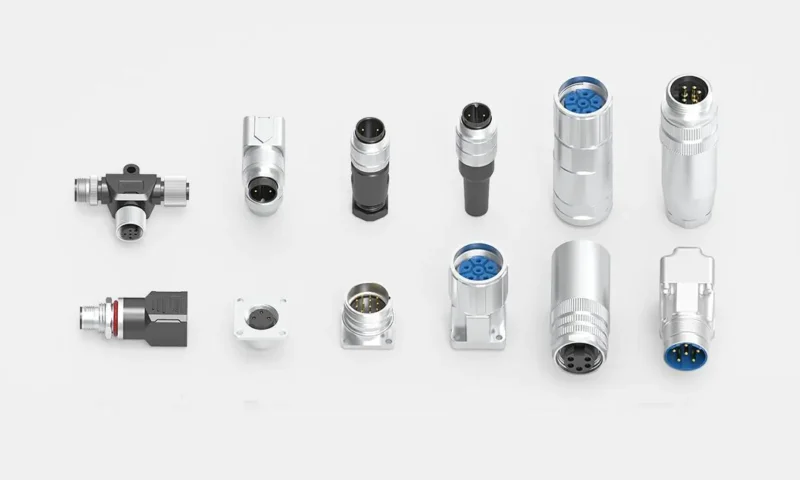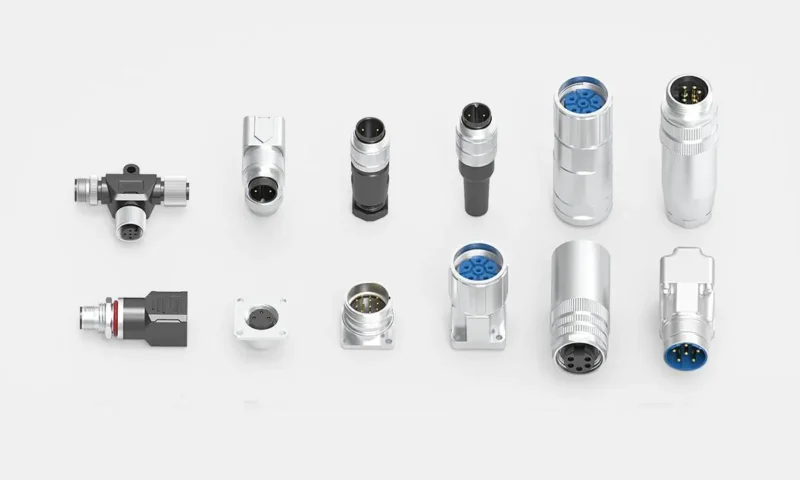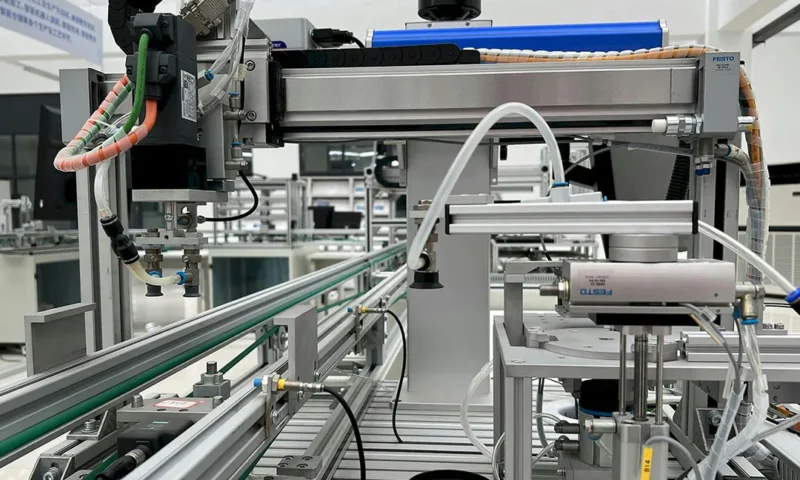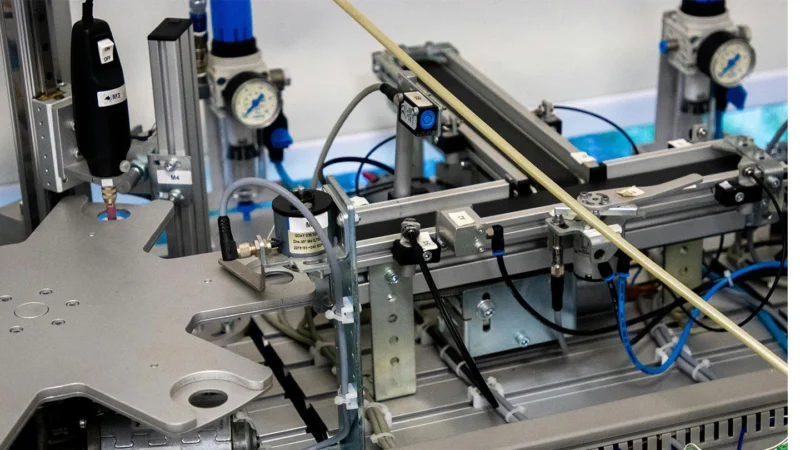
As industrial Ethernet continues to expand rapidly, data transmission speed and noise immunity have become critical factors determining the efficiency of automation systems. The M12 circular connector, as the most common interface solution in industrial field, comes in different coding types—X-coded and D-coded—which often creates confusion for engineers during the selection process.
This article provides a clear comparison from two dimensions: technical specifications and application scenarios, helping readers make informed decisions based on actual requirements.
I. Technical Parameter Comparison
1. Transmission Speed
The most fundamental difference between the two lies in bandwidth capability.
| Coding Type | Max Transmission Speed | Supported Protocols |
|---|---|---|
| D-coded | 100 Mbps | PROFINET, EtherNet/IP, EtherCAT |
| X-coded | 10 Gbps | Gigabit Ethernet, PROFINET, EtherNet/IP |
D-coded is designed for Fast Ethernet with a 4-pin configuration, suitable for sensors and I/O modules with low data throughput. X-coded supports 10 Gigabit Ethernet with an 8-pin design, fully utilizing the bandwidth of Gigabit Ethernet.
Conclusion: Choose D-coded for low-speed signals, and X-coded for high-speed, high-volume data transmission.
2. Shielding and Noise Immunity
Electromagnetic interference (EMI) in industrial environments is a major factor affecting communication quality.
| Coding Type | Shielding Structure | Noise Immunity |
|---|---|---|
| D-coded | Overall metal shielding | Good, suitable for general industrial environments |
| X-coded | Individual shielding per pair + overall shielding | Excellent, suitable for strong interference scenarios like VFDs and welders |
The internal structure of X-coded is similar to Cat6A cabling—each twisted pair has its own aluminum foil shield, with an additional braided shield covering all pairs. This design maintains 10 Gbps high-speed transmission without packet loss even in harsh EMI environments.
3. Pin Configuration and Keying Design
Both share the same physical size (M12×1 thread), but the internal plug structures are completely different and not interchangeable.
Important Note: D-coded and X-coded plugs cannot be used interchangeably. Forcing a mismatch will damage the connector pins or housing. Always verify the coding mark on the device interface before installation.
4. Quick Identification Method
| Identification Feature | D-coded | X-coded |
|---|---|---|
| Number of pins | 4 metal pins | 8 metal pins (finer) |
| Keyway shape | 1 wide keyway | 4 narrow keyways |
| Internal plug layout | Sparse pin arrangement | Denser pin arrangement |
Simplest method: Count the pins—4 pins means D-coded, 8 pins means X-coded.
1.Comprehensive Comparison Table
| Parameter | M12 D-coded | M12 X-coded | Explanation |
|---|---|---|---|
| Transmission Speed | 100 Mbps | 10 Gbps | X-coded is 100x faster than D-coded |
| Number of Pins | 4-pin | 8-pin | X-coded supports all four pairs of Gigabit Ethernet |
| Shielding Structure | Overall shielding | Per-pair + overall shielding | X-coded offers stronger noise immunity |
| Typical Protocols | PROFINET, EtherNet/IP | Gigabit Ethernet, PROFINET | Different application tiers |
| Relative Cost | Lower | Higher | X-coded has more complex construction |
| Market Maturity | Very mature | Rapidly growing | X-coded represents the future trend |
2. Application Scenarios and Selection Guidelines
Scenario 1: Distributed I/O and Field Sensors — D-coded
In factory floor remote I/O stations, proximity sensors, photoelectric sensors, and similar devices, the data throughput per node is typically just tens to hundreds of bytes. The 100 Mbps D-coded connector is more than sufficient, with lower cost and a more mature supply chain.
Typical Devices: PROFINET remote I/O modules, valve islands, temperature transmitters
Scenario 2: Servo Drives and Motion Control — Depends on the Case
- Standard servos (1-4ms control cycle): D-coded works perfectly, and most mainstream brands use D-coded as standard.
- High-end servos (multi-axis, high synchronization requirements): When the number of servo axes is high and synchronization precision is critical, the bandwidth headroom provided by X-coded significantly reduces bus load.
Field Reference: In a lithium battery winding machine project with 12 servos controlled via EtherCAT, upgrading to X-coded reduced bus load from 72% to 21%.
Scenario 3: Machine Vision and High-Definition Video — X-coded Required
A 5-megapixel industrial camera capturing at 30fps generates an uncompressed data stream of 3-5 Gbps. The 100 Mbps D-coded cannot handle this load.
Field Reference: In a PCB optical inspection system, upgrading the camera interface from D-coded to X-coded reduced single-board inspection time from 3.8 seconds to 1.6 seconds.
Scenario 4: Robot Controllers and Industrial Gateways — X-coded Trending
Collaborative robots, AGVs, and industrial 5G gateways need to transmit multiple data types simultaneously—control commands, status feedback, video streams. The 8-pin design of X-coded can carry Gigabit data + PoE power + IO-Link signals in a single cable, significantly simplifying device wiring.
Scenario 5: Rail Transit and In-Vehicle Ethernet — X-coded Replacing Legacy Solutions
In applications such as train-to-carriage connections, metro PIS systems, and onboard CCTV, M12 X-coded is gradually replacing older D-coded solutions due to its vibration resistance and IP67 protection rating.
3. Quick Selection Guide
| Decision Factor | Recommended Coding |
|---|---|
| Sensors, I/O modules, small data volume | D-coded |
| 5-megapixel or higher industrial camera | X-coded |
| Equipment located near VFDs or welders | X-coded |
| Standard servo with control cycle >1ms | D-coded |
| 16+ axes high-synchronization servo system | X-coded |
| Tight budget, short-term project | D-coded |
| New production line with 3-5 year outlook | X-coded |
Three Core Principles:
- Transmitting video or large real-time data → X-coded
- Located near high-power VFDs → X-coded
- Unsure and budget allows → X-coded (leave yourself headroom)
4. Xmost Industry Product Solutions
Shenzhen Xmost Industry Co., Ltd. offers a full range of M12 industrial Ethernet connectors covering both D-coded and X-coded types, compatible with PROFINET, EtherNet/IP, EtherCAT, and other mainstream protocols.
Product Line Comparison
| Comparison Item | M12 D-coded Series | M12 X-coded Series |
|---|---|---|
| Number of Pins | 4-pin | 8-pin |
| Transmission Speed | 100 Mbps | 10 Gbps |
| Shielding Structure | Overall braided shielding | Per-pair aluminum foil + overall braided shielding |
| Protection Rating | IP67 | IP67 |
| Cable Specification | PVC or PUR jacket | S/FTP Cat6A, 4-pair 26AWG |
| Transmission Distance | 100 meters | 100 meters @ 10 Gbps |
| Form Factor | Straight / angled overmolded cable | Overmolded cable / panel mount |
| Operating Temperature | -25°C to +80°C | -40°C to +85°C |
| Typical Applications | I/O modules, valve islands, standard servos, sensors | Machine vision, high-end servos, robotics, 5G gateways |
| Relative Cost | Lower | Higher |
5.Quick Selection Reference
| Your Requirement | Recommended Product |
|---|---|
| I/O modules, indoor dry environment | D-coded PVC straight |
| Motion control with oil exposure, requires flex resistance | D-coded PUR angled |
| 5MP camera, noise immunity required | X-coded Cat6A shielded cable |
| Near VFDs, strong EMI environment | X-coded per-pair independently shielded |
| Gigabit backbone between controllers | X-coded Cat6A overmolded cable |
6. Conclusion
Neither D-coded nor X-coded is inherently superior—the right choice depends entirely on your actual requirements.
- D-coded: Mature, economical, sufficient. Suitable for 100 Mbps networks with I/O devices and general industrial environments.
- X-coded: High-speed, noise-immune, future-proof. Suitable for Gigabit/10 Gigabit networks, harsh EMI environments, and projects requiring upgrade headroom.
Selection advice: Match the specification to your need without overkill, but leave headroom when uncertain. The cost of field wiring and downtime far exceeds the price difference of the connector itself.
Shenzhen Xmost Industry Co., Ltd. offers a full range of M12 industrial Ethernet connectors. Contact us for samples and technical support.