A Practical Selection Guide Based on 2026 Market Data
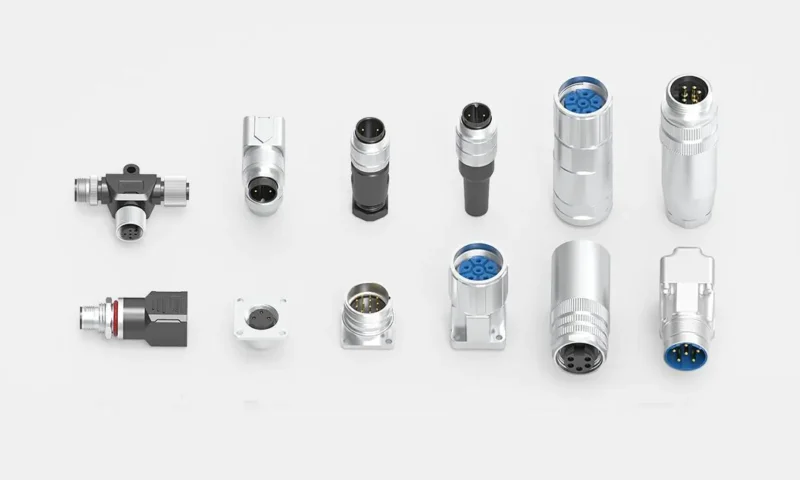
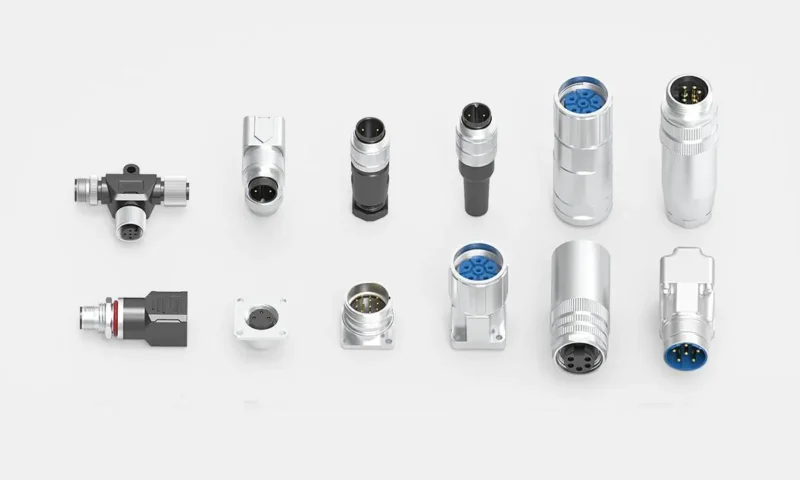
When specifying industrial circular connectors for factory automation, robotics, IIoT devices, or sensor connectivity, engineers often face a simple but critical question: M5, M8, or M12?
number after “M” refers to the metric thread outer diameter in millimeters. But the difference is not just about physical size — it directly impacts current rating, vibration resistance, IP rating, data speed, and overall system reliability.
Based on 2025–2026 market data and the latest SPE (Single Pair Ethernet) trends, this connector selection guide will help you make the right call for your industrial communication and fieldbus applications.
Quick Spec Comparison
| Parameter | M5 Connector | M8 Connector | M12 Connector |
|---|---|---|---|
| Diameter | 5 mm | 8 mm | 12 mm |
| Rated Current | ≤ 1 A | ≤ 3 A | ≤ 12 A (L-coded) |
| Rated Voltage | ≤ 60 V | ≤ 60 V | ≤ 630 V |
| Common Protocols | Discrete signals | Sensors, I/O, SPE | Profinet, EtherCAT, 10G Ethernet, Power |
| IP Rating | IP67 | IP67 – IP68K | IP67 – IP69K |
| Vibration Resistance | Low | Good | Excellent |
| Typical Applications | Miniature sensors, PCBs | Compact I/O blocks, actuators | Servo motors, control cabinets |
Choose M5 Connectors ONLY when:
- The device is too small to accommodate an M8 (e.g., micro photoelectric sensors)
- The environment is completely static with no vibration risk
- Power requirement is below 1A
- You need space-saving connectivity for high-density PCB mounting
Choose M8 Connectors as your FIRST CHOICE for 80% of applications:
- SPE (Single Pair Ethernet) ready — the future of industrial communication
- 3A current capacity for sensors and actuators
- Good vibration resistance with locking mechanism
- Saves 30% panel space compared to M12
- Ideal for decentralized I/O modules and field devices
- If you are torn between M5 and M8 — always pick M8
Choose M12 Connectors ONLY when:
- You need to carry more than 10A (L-coded power connector)
- You require 10 Gigabit Ethernet (X-coded M12)
- The application involves extreme shock or vibration
- High power motor feeds or servo drives are involved
- You need A-coded, B-coded, or D-coded options for standard industrial protocols
Three-Step Decision Flow for Connector Selection
Step 1: Power & Signal Type
Step 2: Vibration Environment
- High vibration (machine tools, packaging lines) → Avoid M5. Use M8 with anti-vibration locking or M12.
- Static / low vibration → Any size works.
Step 3: Installation Density
- Dense I/O banks or valve islands → M8 or M5 (M12 is too bulky)
- Standalone device → M12 is fine
*Static & tiny → M5 connector. Reliable & compact → M8 connector is the smart money. High power / 10G / tough → M12 connector.*
Based on 2026 market data, the M8 connector delivers the best return on value for most general sensor and actuator applications. It is more reliable than M5 (higher current + better vibration resistance) and more compact than M12 (saving over 30% panel space).
Only step up to M12 connectors when power or speed demands it. Only drop down to M5 connectors when physical space leaves you no other choice.
For waterproof circular connectors with high IP ratings, all three sizes are available with IP67K protection.