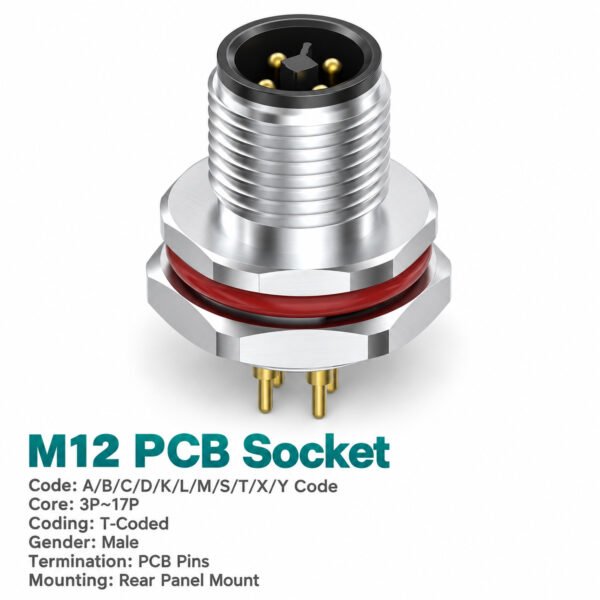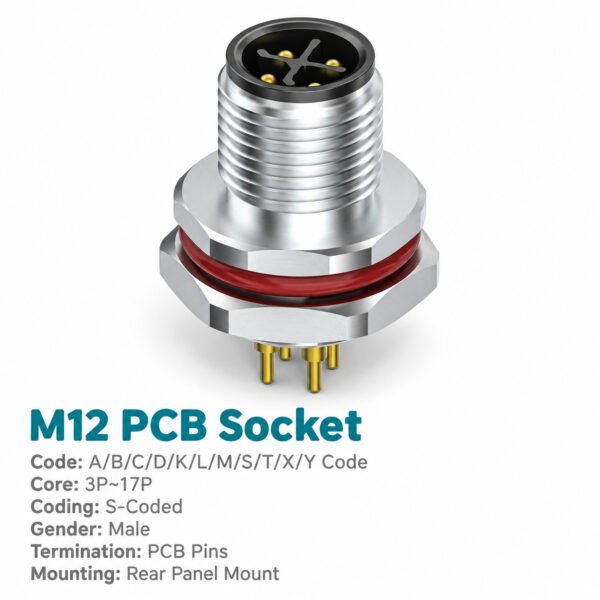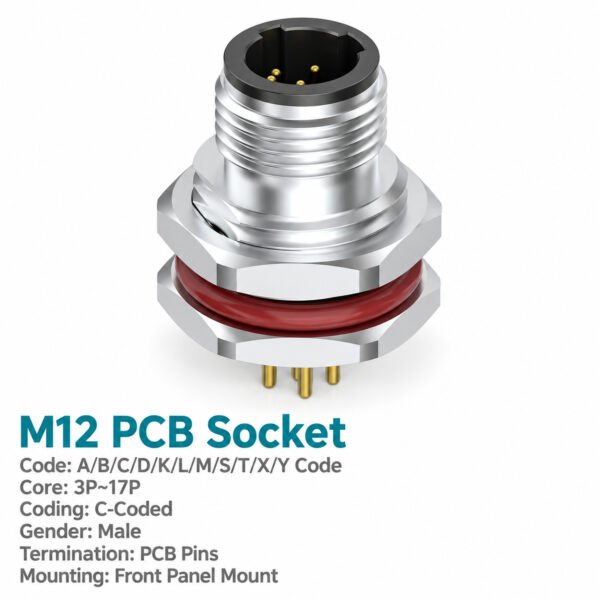
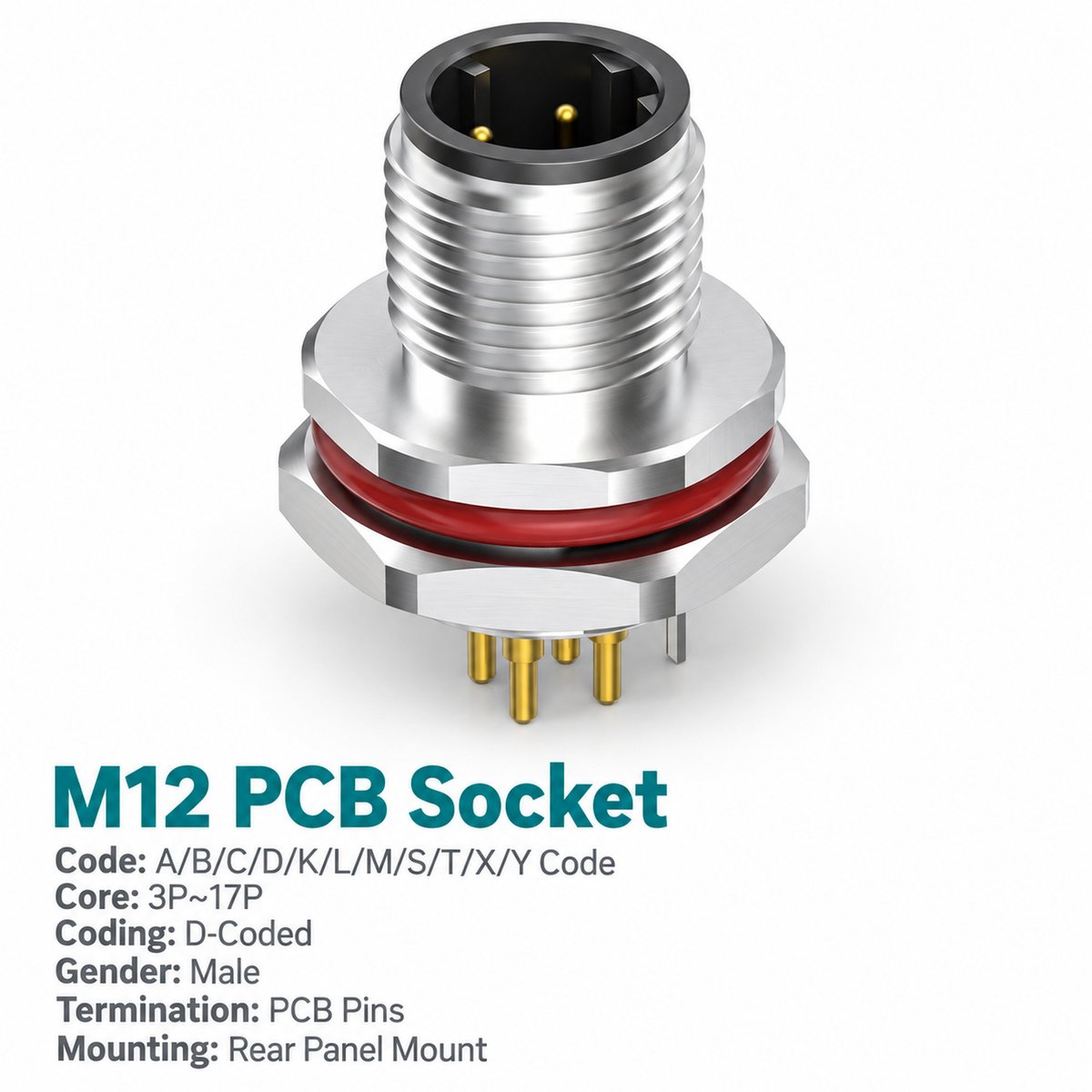
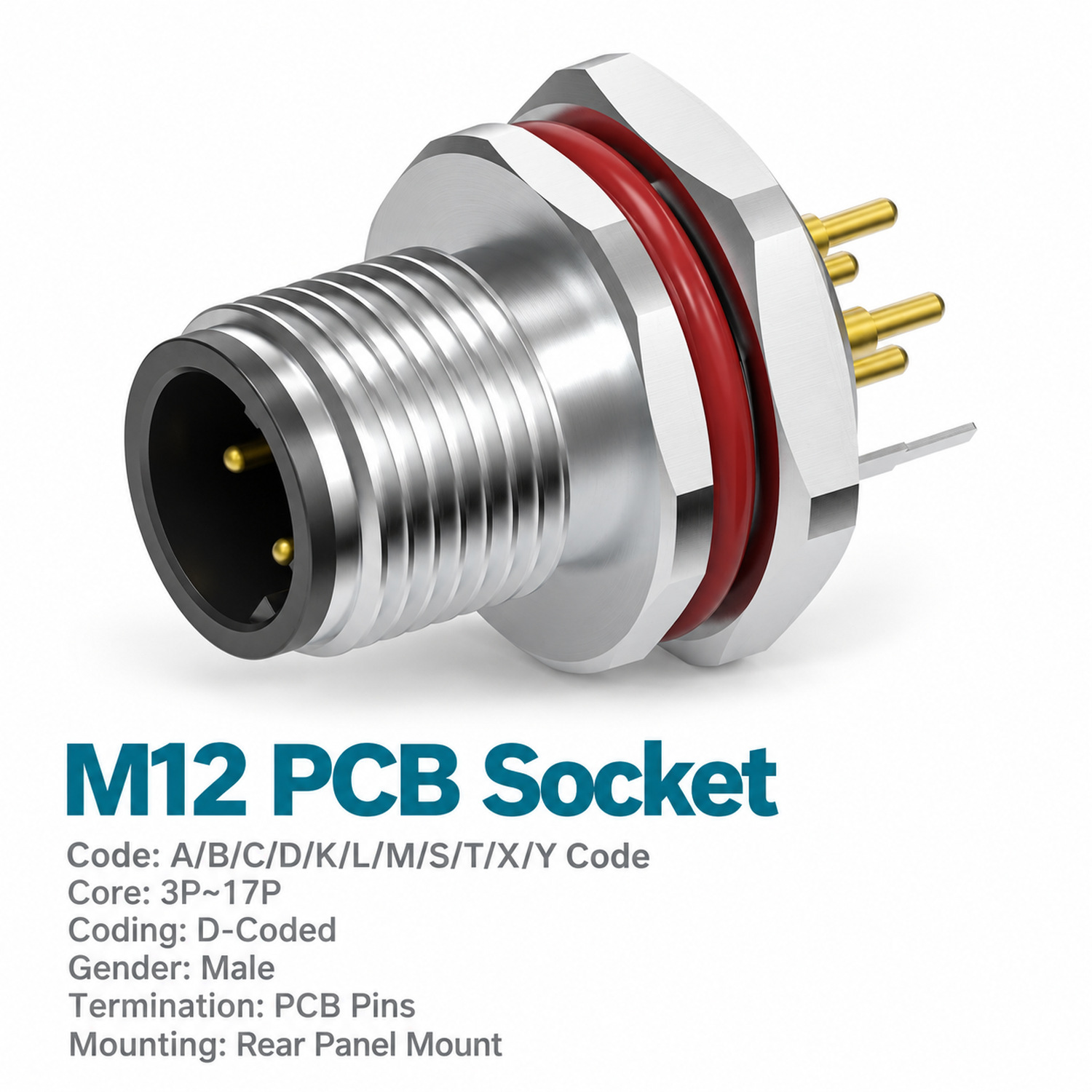
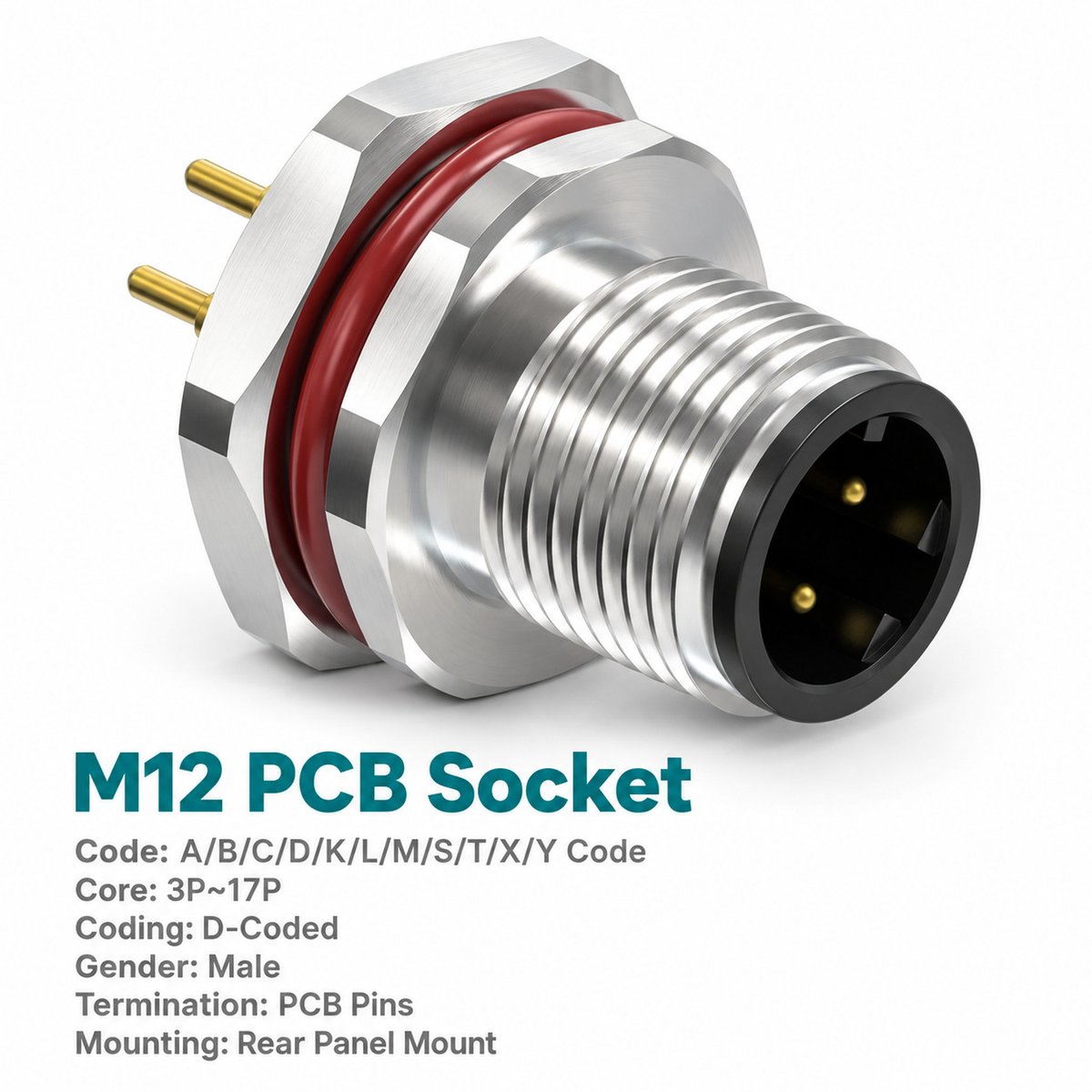
M12 D-coded male rear mount PCB connector links an external industrial Ethernet cable assembly to the circuit board inside a network-enabled device. The male interface accepts a compatible 4-pin D-coded female connector, with rear insertion contacts providing PCB dip-solder termination.
Designed for rear fastened installation, this M12 panel mount Ethernet connector suits housings with a defined panel-to-board position. Its rear mount outline differs from the front mount version and should be used when checking enclosure clearance and PCB placement.
The catalogue identifies PROFINET and Ethernet applications and lists grounding and shielding choices. Specify these requirements together with the mounting thread when selecting the complete equipment interface.
Key Features
- Rear fastened panel connection: For equipment enclosures designed around a rear mount M12 connector.
- Male D-coded interface: Connects to matching 4-pin female industrial Ethernet cable assemblies.
- PROFINET / Ethernet use: Provides a detachable network cable interface at the equipment housing.
- Direct PCB termination: Straight contacts support board insertion and dip soldering.
- Shielding selection: Available in shielded and unshielded versions.
- Grounding options listed: Specify the required grounding construction separately from shielding.
Product Dimensions
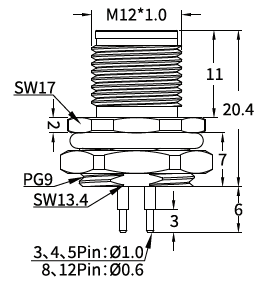
[Insert the male rear mount outline drawing and corresponding panel cut-out drawing from page 9.]
Illustrated PG9 Rear Mount Version — Dimensions in mm
| Item | Drawing Value |
|---|---|
| Mating thread | M12 × 1.0 |
| Panel mounting thread shown | PG9 |
| Body dimension shown, excluding PCB contacts | 20.4 |
| Upper axial section | 11 |
| Flange section | 2 |
| Lower axial section | 7 |
| Upper wrench size | SW17 |
| Lower wrench size | SW13.4 |
| Rear contact section | 6 |
| Contact tip section | 3 |
| PCB contact diameter, 4-pin version | Ø1.0 |
Needle Arrangement (Front View)

[Insert the D-coded 4-pin male needle arrangement diagram from page 9.]
The diagram shows the male connector from the mating face, with contacts numbered 1–4. Match the arrangement to the female cable connector and use the equipment wiring specification for network signal assignments.
Product Specifications
| Parameter | Specification |
|---|---|
| Product type | M12 D-coded male rear mount PCB connector |
| Application type | PROFINET / Industrial Ethernet |
| Mounting | Rear fastened |
| Contact count | 4 pins |
| Termination | PCB dip soldering |
| Standard listed | IEC 61076-2-101 |
| Rated current | 4 A |
| Rated voltage | 250 V |
| Grounding options listed | Grounded / ungrounded |
| Shielding options | Shielded / unshielded |
| Mating thread | M12 × 1.0 |
| Panel mounting options | PG9 / M16 × 1.5; additional M12 option to be confirmed |
| Insulation resistance | ≥100 MΩ |
| Contact resistance | ≤5 mΩ |
| Recommended coupling torque | 0.4 N·m |
| Maximum coupling torque | 0.8 N·m |
| Temperature range, flexible use | −25°C to +80°C |
| Temperature range, static use | −40°C to +80°C |
| Protection ratings listed | IP67 / IP68 |
| Pollution degree | 3 |
| Insulator materials listed | PA66+GF / TPU+GF |
Applications
- Industrial Ethernet modules: Connects external network cables to internal PCB communication circuits.
- PROFINET I/O equipment: Provides a D-coded panel interface for distributed automation devices.
- Industrial gateways: Integrates a threaded M12 network connection into communication equipment.
- Machine control housings: Suits rear fastened assemblies requiring board-level Ethernet termination.
Selection and Ordering
| Selection Item | Available Choices |
|---|---|
| Interface | M12 D-coded male, 4-pin |
| Mounting style | Rear mount |
| Termination | PCB dip soldering |
| Panel mounting thread | PG9 / M16 × 1.5; additional M12 option to be confirmed |
| Grounding | Specify grounded / ungrounded requirement |
| Shielding | Shielded / unshielded |
Example enquiry: M12 D-coded male rear mount PCB Ethernet connector, 4-pin, M16 × 1.5 mounting, shielded version, with grounded construction required.